How to play Taluva
Taluva is a tile-laying and building game. You and your opponent grow a volcanic island together, then raise settlements of huts, temples, and towers on it. Each turn has two steps, in order: place a volcano tile, then place one or more of your buildings. The board is a shared landscape; your buildings are how you claim it.
Winning. Two ways to win. The fast way is to be the first to put all of your pieces of two of the three building types onto the island — that ends the game immediately. Otherwise, when the last volcano tile is placed, the player with the most temples wins; ties break on towers, then on huts (counting huts that eruptions have destroyed, too).
New to the game? Skim the quick reference at the bottom, then come back for the detail.
The island and the pieces
The island is built from volcano tiles. Each tile is a single piece of three hexes joined together: one volcano field (with its lava flow) and two terrain fields. The five terrains you can build on are jungle, clearing, sand, rock, and lake. A few sample tiles:
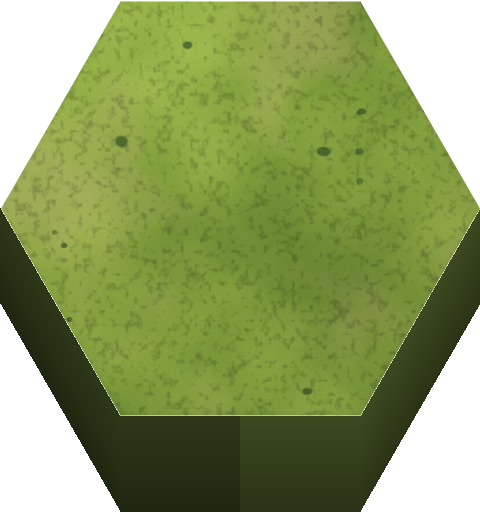
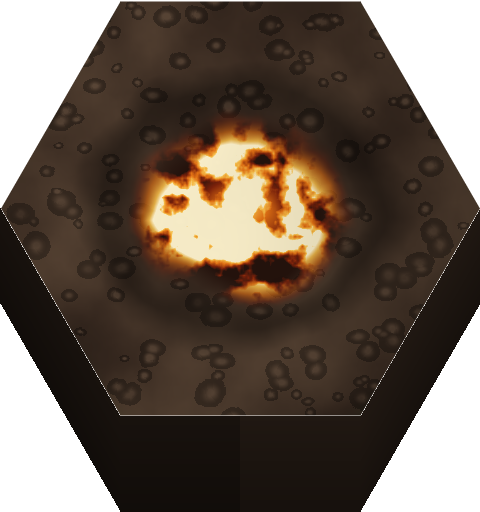


volcano + two terrains

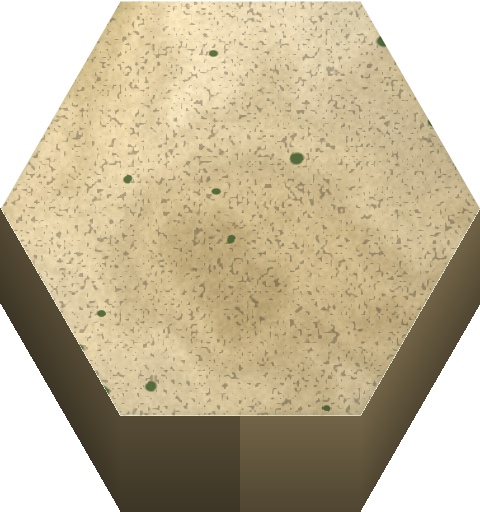
volcano + two terrains
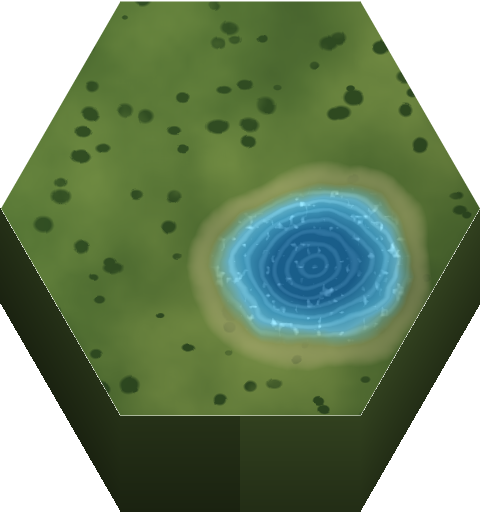
volcano + two terrains
Tiles stack into levels. A field's level is the height of the tile stack there: an open field on the table is level 1, a field built on top of another is level 2, and so on. Higher fields are harder to reach but they unlock the stronger buildings.
Each player has a colour and a construction pool of buildings, drawn from a finite supply:

20 per player

3 per player

2 per player
Four player colours: red yellow white brown.
A settlement is any group of your buildings that touch, edge to edge. A single hut is a settlement of one; it grows as you add pieces next to it. Two of your settlements that touch become one.
A turn
Players take turns. On your turn you do two things, and you must do both:
- Place a volcano tile. Draw one tile and add it to the island (see below).
- Place one or more buildings. Put at least one piece from your pool onto the island (see below).
Step 1 — place a volcano tile
Draw one tile. On the very first turn of the game it goes anywhere in the middle. After that, choose one of two ways to place it:
Expand the landscape
Lay the tile onto empty table next to the island. At least one edge of the new tile must touch a tile already on the table.
Volcanic eruption
Stack the tile on top of tiles already placed. An eruption must follow these rules:
- The tile's volcano field lands on a field that is already a volcano.
- The new volcano must point a different direction than the one it covers.
- The tile must sit flat: no empty space beneath it, and the three fields it rests on must all be the same level.
An eruption may cover huts — yours or an opponent's. Buried huts leave the game (sent to the box, not back to anyone's pool), and a settlement can be split in two by losing the huts that joined it. But an eruption may not cover temples or towers, and it may not bury a settlement completely — at least one building of any settlement you touch must remain.
Buried huts are gone from the board but still count as "built" for the final score.
Step 2 — place buildings
Buildings go only on empty fields that are not volcanoes. You may join two of your own settlements together. You must place at least one piece; if you cannot, you are eliminated (see below). Choose one of these:
Build a hut
Place one hut on any empty, level-1 field. A hut on its own is how a new settlement gets started.
Build a tower
Place one tower on a level-3-or-higher field that touches one of your settlements — and that settlement must not already have a tower.
Build a temple
Place one temple on a field of any level that touches one of your settlements of at least three buildings — and that settlement must not already have a temple.
Expand a settlement
Expanding is the one build that puts several huts on the board at once. Pick one of your settlements and one terrain type (jungle, clearing, sand, rock, or lake). You then place huts on every empty field of that terrain that touches the settlement. Each field costs as many huts as its level: one hut on a level-1 field, two on a level-2 field, three on a level-3 field. You must have enough huts in your pool to pay for all of them at once.
Whichever you pick, you must have the pieces for it in your pool, and every requirement has to hold at the moment you build.
Elimination and game end
Elimination
You must place at least one building each turn. If, after placing your tile, you have no legal build at all, you are eliminated: your turns are skipped for the rest of the game, but the buildings you already placed stay on the island.
Game end
The game ends in one of two ways:
- Early victory. The moment you have placed all of your pieces of two of the three building types, you win at once.
- Regular end. When the last volcano tile is placed, the game ends. Among the players still in, the most temples wins; ties break on towers, then on huts. Eliminated players are not counted.
Quick reference
- A turn
- 1) place a tile (expand or erupt), 2) place one or more buildings.
- Hut
- One hut on any empty level-1 field. Starts a new settlement.
- Tower
- Level 3+, touching your settlement that has no tower yet.
- Temple
- Any level, touching your settlement of 3+ buildings with no temple yet.
- Expand
- One settlement + one terrain: huts on all adjacent empty fields of that terrain; cost = the field levels summed; you must afford all.
- Eruption
- Volcano on a volcano, different direction, sits flat on one level. May cover huts (to the box), never temples or towers, never a whole settlement.
- Win
- Early: all of two building types placed. Otherwise, when tiles run out: most temples, then towers, then huts.
As implemented here
- This server hosts two-player, play-by-web games. Each player has their own private link; you make your move, close the tab, and the server emails your opponent that it is their turn. There is no hotseat mode and no AI on this build.
- With two players, eliminating your opponent ends the game at once — you win immediately, and the remaining tiles are not played out. (The published game instead keeps skipping an eliminated player's turns until the tiles run out.)
- The tile deck is seeded, so a game is fully determined by its seed and the sequence of moves. That is what lets the server offer a take-back of your current turn without letting you re-roll the tile you drew.
- You can take a turn back as long as it is still yours. Once the turn passes to your opponent, the move stands.
Taluva is by Marcel-André Casasola Merkle (Hans im Glück, 2006). This page restates the rules in our own words for players of this site; the published rulebook is the authority.